Meta Ads Aren't Broken. Your Creative Strategy Is.
 By Akshat Singh··7 min read·Paid Advertising
Key Takeaways
- Meta's algorithm didn't break. It stopped rewarding average advertisers and started rewarding businesses with better creative, offers and data.
- Creative is the new targeting: your ads' hooks and angles tell Meta who to show them to.
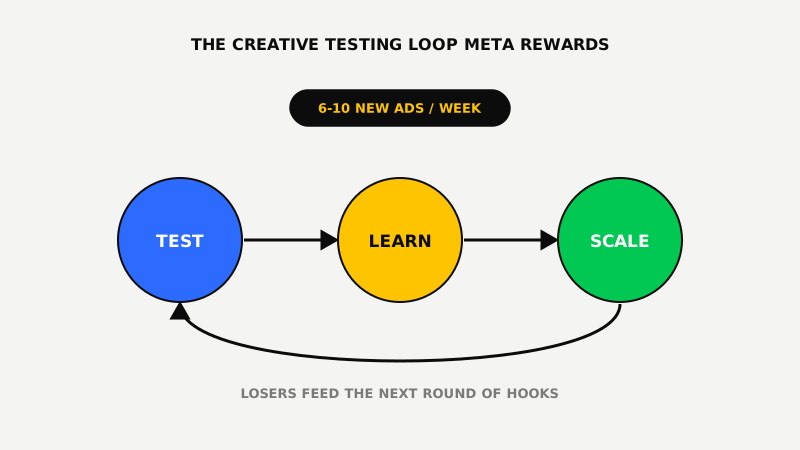
- Fatigue is a system problem, not a platform problem. Winning accounts ship 6-10 new creative variations weekly through a test-learn-scale loop.
- Rising CPMs punish weak creative twice: you pay more for attention and convert less of it.
Stop Blaming Meta
Every week, thousands of business owners say the same things. "Meta Ads don't work anymore." "Facebook is dead." "iOS destroyed advertising." "Leads got expensive."
Then explain this: why are thousands of businesses still scaling profitably on Meta every single day, right now, in the same auctions you're losing?
The algorithm isn't broken. It just stopped rewarding average advertisers.
In 2021, mediocre creative could win because targeting did the heavy lifting. Then signal loss changed the game. Today Meta finds your customers based on who engages with your creative. Your hooks, your angles and your offers are the targeting.
Creative Fatigue Is A System Problem
Running the same creative for four months isn't optimization. Duplicating campaigns isn't scaling. Increasing budgets by 20% isn't strategy.
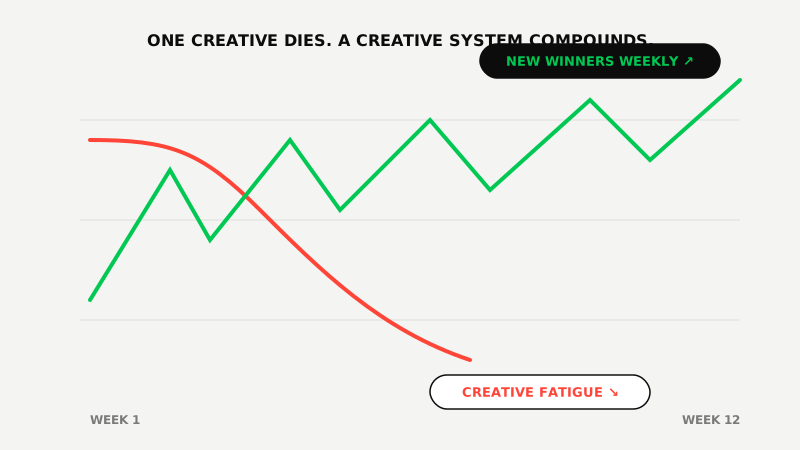
Every creative has a decay curve. It launches, finds its audience, peaks, then fatigues as frequency climbs and CPMs rise. If you have no pipeline of new creative behind it, your account's performance is just that decay curve in slow motion.
The Creative Testing Loop Meta Rewards
The accounts that scale in 2026 all run some version of the same loop:
- Test. 6-10 new creative variations per week. Not random: structured tests of hooks, angles, formats and offers against clear hypotheses.
- Learn. Judge by thumb-stop ratio, hook rate, CTR and, above all, cost per profitable acquisition. Interesting metrics support decisions; they don't replace them.
- Scale. Winners get budget and new variations. Losers get autopsied: the failed hook often becomes next week's winning angle with one change.
The Parts Around The Ads Matter More Than The Ads
Meta doesn't reward advertisers anymore. It rewards businesses. Better offers. Better landing pages. Better tracking. Better customer experience. If your pixel feeds Meta garbage signals, or your landing page leaks trust, the best creative in the world just makes you lose money faster.
- Offer: the strongest creative can't sell a weak offer. Fix the offer first.
- Tracking: clean pixel + Conversion API events decide how well Meta's AI learns.
- Landing page: clicks don't create revenue. Conversions do.
- Retention: LTV headroom is what lets you outbid competitors for the same customer.
We rebuilt one account's creative strategy and signals and watched purchase ROAS climb from 3.05 to 5.77 while purchases more than doubled. The full breakdown is on our Meta Growth Proof Program™ page.
Your 5-Minute Creative Audit
- How many net-new creatives did you launch in the last 30 days? (Winning accounts: 20+)
- Do you know your current winning hook, and why it wins?
- Is any ad set's frequency above 3 with declining CTR?
- Are you testing angles (pain, proof, curiosity, offer) or just colors?
- When a creative dies, does anything systematic replace it?
If those answers hurt, the problem was never the algorithm.
Want your Meta account rebuilt around a creative system that scales?
See The $800 Meta Growth Proof Program™ ↗