Why Most Google Ads Accounts Need A Rebuild, Not More Optimization
 By Akshat Singh··8 min read·Paid Advertising
Key Takeaways
- Most underperforming Google Ads accounts have structural problems that no amount of weekly tweaking can fix.
- The 5 rebuild signals: falling ROAS despite optimization, campaigns competing against each other, polluted conversion data, over-reliance on Google's automated recommendations, and no search term control.
- A proper rebuild restructures campaigns around buyer intent, fixes conversion tracking first, and gives smart bidding clean data to learn from.
- Expect a 2-4 week learning period after a rebuild. The businesses that accept it scale past competitors who keep polishing a broken structure.
The Optimization Trap
Here's a conversation we have almost every week. A business owner tells us their Google Ads agency has been "optimizing" the account every single week for a year. Then we ask one question: are your profits growing every month?
Silence.
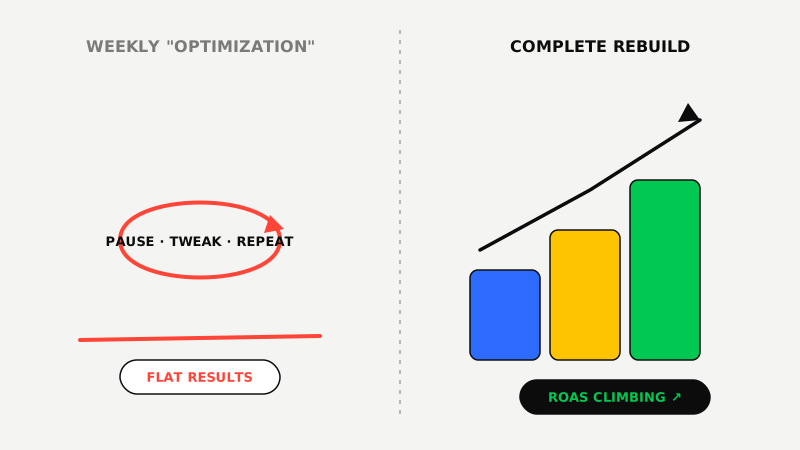
Higher CPCs. Rising cost per acquisition. Falling ROAS. Less qualified leads. If the account has been optimized weekly for a year and the numbers keep getting worse, the problem is not optimization. You're trying to optimize a broken system. That's like polishing a Ferrari with no engine. No amount of polishing makes it faster.
Maintenance doesn't create growth. Rebuilding does.
5 Signs Your Google Ads Account Needs A Rebuild
1. ROAS keeps falling no matter what gets "optimized"
Pausing a keyword here, changing a headline there. That's maintenance, not strategy. When results decline despite constant activity, the account architecture itself is capping performance.
2. Your campaigns compete against each other
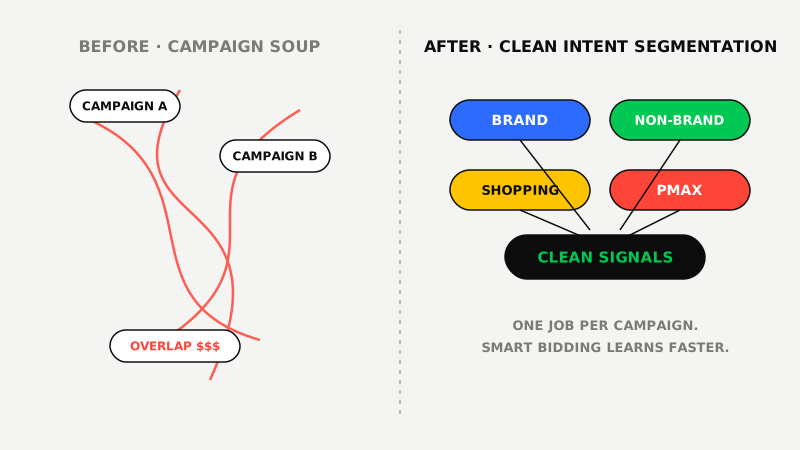
Overlapping keywords, duplicated audiences and loose match types force your own campaigns to bid against each other in the same auctions. You pay a premium to beat yourself.
3. Your conversion tracking is lying to you
Duplicate conversions, missing values, micro-conversions treated like purchases. Smart bidding is only as smart as the data you feed it. Bad data in, bad decisions out, expensive results back.
4. Every Google recommendation gets applied automatically
Google's recommendations are designed to help Google. Broad match everything, maximize budgets, enable every automation. Funny how almost every recommendation increases Google's revenue before yours.
5. Nobody can explain the search terms you're paying for
Open your search terms report. If a meaningful chunk of spend goes to queries that will never buy from you, the structure has no intent control.
What A Proper Rebuild Actually Looks Like
- Fix conversion tracking first. Before touching a single campaign, verify every conversion action, value and attribution setting. Scaling on bad data is gambling.
- Restructure around buyer intent. Brand, non-brand, shopping and Performance Max each get one clear job, one clean signal set and one budget logic.
- Rebuild search term control. Tight match type strategy plus a serious negative keyword architecture. Every dollar gets a purpose.
- Reset smart bidding with clean signals. Automated bidding works brilliantly when it's controlled. It fails when it controls you.
- Connect the account to the business. Landing pages, offers and margins decide what a click is worth. The account has to reflect that, not ignore it.
The Part Nobody Tells You: The Learning Period
A rebuild resets machine learning. Expect 2 to 4 weeks of recalibration while Google's systems relearn from clean signals. This is exactly why most agencies never rebuild: it's uncomfortable to explain. It's also why accounts that go through it come out the other side scaling profitably while competitors keep polishing a structure that peaked two years ago.
We've used this exact process to take accounts from stagnant to $22.9M in revenue at 632% ROAS. Not by tweaking. By rebuilding around profitability.
Should You Rebuild It Yourself?
If you have senior in-house PPC talent, this article is your checklist. If you don't, be careful who you hand it to: the industry standard is a 6-month contract before anyone proves they can do this. We think that's backwards, which is why our Google Ads Proof Program™ includes a complete audit and rebuild in your first month for $600. You see the rebuilt system working before you ever pay agency-level fees.
Want us to rebuild your Google Ads account and prove it works?
See The $600 Google Ads Proof Program™ ↗